
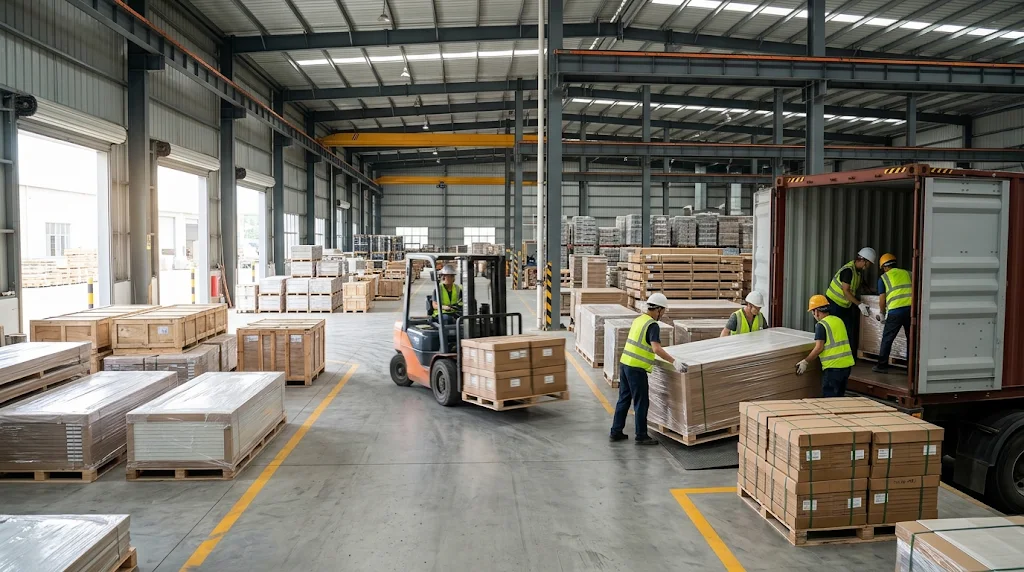
The global construction materials market was valued at approximately USD 1.42 trillion in 2025, and it continues to grow at a steady CAGR of around 3.9% through 2034 (Fortune Business Insights). Asia Pacific accounts for roughly 48.8% of that market, and at the center of it sits China — the world’s largest producer and exporter of construction materials, furniture, fixtures, and interior finish products.
For developers, contractors, importers, and hospitality procurement teams, learning how to import building materials from China is no longer an exotic strategy. It is standard practice. Industry procurement specialists consistently report cost savings of 30–60% compared with local procurement for comparable quality — but those savings only hold when the process is managed correctly: verified suppliers, locked specifications, independent inspections, and disciplined logistics.
This guide walks through the complete workflow that experienced project buyers follow in 2026, from the first inquiry to the moment your container clears customs.
Why Source Building Materials from China?
1. Cost advantage that survives the landed-cost math
Chinese factory pricing on kitchen cabinets, doors and windows, flooring, tile, sanitary ware, lighting, and furniture typically runs 40–60% below Western wholesale prices. Even after adding ocean freight, insurance, duties, and inland delivery — the full “landed cost” — most project buyers still realize net savings of 30–50% on their material budget. On a USD 500,000 FF&E package for an apartment or hotel project, that difference funds an entire additional floor of finishes.
2. The world’s deepest manufacturing clusters
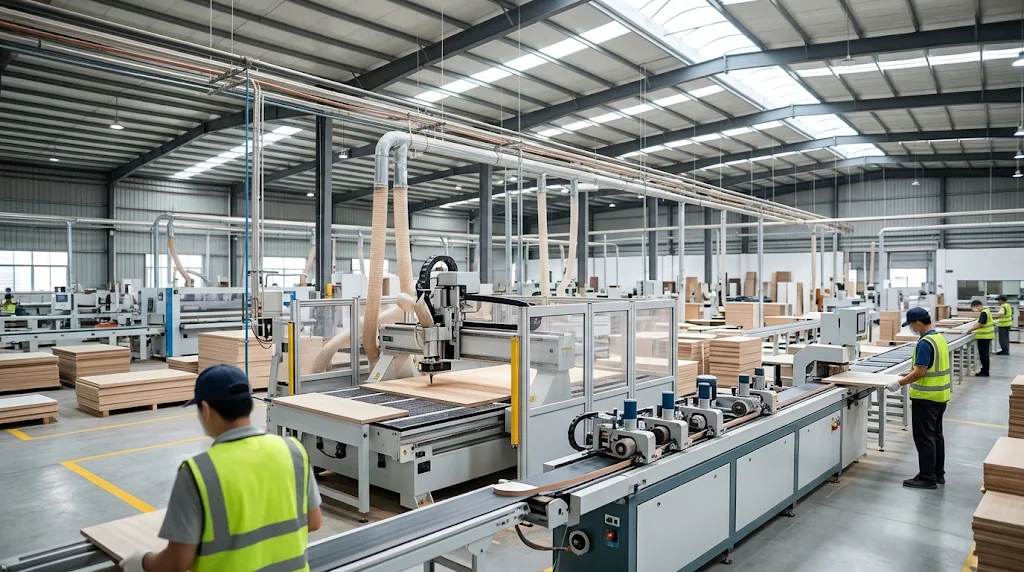
China’s building materials industry is organized into specialized production clusters: ceramic tile in Foshan, hardware in Yongkang, sanitary ware in Chaozhou and Foshan, lighting in Guzhen, furniture in Foshan and Dongguan. According to the General Administration of Customs of China, China exported approximately USD 65.1 billion worth of furniture and parts in 2025, and wooden furniture alone accounted for USD 24.57 billion in 2024, shipped to more than 200 countries. This depth means every product category on your bill of quantities has multiple competing factories — which keeps pricing honest and lead times short.
3. Export-grade quality is now the default
A decade ago, “export quality” was a premium tier. Today, leading Chinese factories routinely produce to ASTM, EN, AS/NZS, CARB, and CE specifications, with in-house labs and third-party test reports. The factories that serve European and North American project markets understand certification requirements because they depend on them.
The 10-Step Import Process
Step 1 — Define specifications before you inquire
The single biggest source of wasted time and budget is a vague brief. Before contacting any supplier, prepare a specification sheet for each product category covering:
- Dimensions, materials, grades, and finishes (e.g., “304 stainless steel,” not “stainless steel”)
- Performance requirements (load ratings, fire ratings, moisture resistance)
- Applicable destination standards (CARB, CE, WaterMark, UL — see the certification table below)
- Packaging and labeling requirements
- Target quantities and destination port
A precise brief converts a generic “price on request” reply into a real, comparable quotation within 48 hours.
Step 2 — Shortlist verified factories, not trading screenshots
Send your brief to 3–5 candidate suppliers per category. A genuine manufacturer will share production-line videos, a factory address, business and export licenses, and recent export records. Cross-check the business license, and treat any price 20% below the group average as a red flag — it usually hides thinner boards, lower hardware grades, or unspecified packaging.
Alternatively, work with a one-stop building materials supplier that has already audited factories across all major product categories — this collapses weeks of supplier screening into a single point of accountability.
Step 3 — Compare quotations like-for-like
Require every quotation to state the same Incoterm (FOB or EXW), minimum order quantity, lead time, payment terms, packaging spec, and price validity period. Only identical specifications can be compared on price.
Step 4 — Approve a paid production sample
Never place a container order from catalog renderings or showroom samples. A paid production sample — made on the actual line, with the actual material — locks four things at once: color match, material thickness and texture, surface finish, and hardware feel. A USD 200 sample routinely protects a USD 20,000 order.
Step 5 — Verify certifications independently
Certification claims must be verified with the issuing body, not taken from a supplier’s brochure. Use this quick-reference table:
| Market | Required certifications | Applies to |
| United States | CARB Phase 2 / EPA TSCA Title VI, UL, ASTM, ANSI/BHMA | Cabinets, furniture, electrical, hardware |
| European Union | CE marking, EN standards, REACH, RoHS | Construction products, finishes, electrical |
| Australia / NZ | WaterMark, AS/NZS standards | Plumbing, sanitary ware, structural |
| Canada | CSA, cUL | Electrical and gas-fired products |
| Global | ISO 9001, ISO 14001, FSC | Factory systems, sustainable timber |
For any wood-based panel product headed to the US — kitchen cabinets, wardrobes, bathroom vanities — CARB Phase 2 / EPA TSCA Title VI compliance is non-negotiable. Shipments have been refused entry over missing composite-wood certification.
Step 6 — Lock the order with clear payment and penalty terms
Standard terms for building materials are 30% deposit, 70% balance before shipment, with inspection rights written into the contract. Include penalty clauses for off-specification goods and late delivery.
Step 7 — Inspect during production and before shipment
Request weekly progress photos during production. When the order reaches roughly 80% completion, book a third-party pre-shipment inspection covering dimensions, moisture content, color consistency across batches, surface finish, labeling, and packaging. Reject and require rework before loading — resolving a defect after the vessel sails is slow and expensive.
Step 8 — Plan freight: FCL beats LCL for building materials
Most building material orders should ship as full container loads (FCL, 20ft or 40ft). Shared containers (LCL) carry a real crushing risk for cabinets, sanitary ware, and lighting. Work with a freight forwarder experienced in construction cargo, and consolidate compatible products from multiple factories into single shipments — consolidation alone frequently cuts total freight cost by 15–25% on multi-category projects.
Step 9 — Prepare customs documentation early
Prepare the commercial invoice, packing list, bill of lading, certificate of origin, and any required test reports well before vessel arrival. Confirm HS codes with a licensed customs broker — misclassification is a common and avoidable source of duty overpayment and clearance delays.
Step 10 — Receive, inspect, and reconcile
Inspect all materials on arrival against the approved golden sample. Document any transit damage immediately for insurance claims, and reconcile quantities against the packing list before signing off.
What Does It Really Cost? A Landed Cost Example
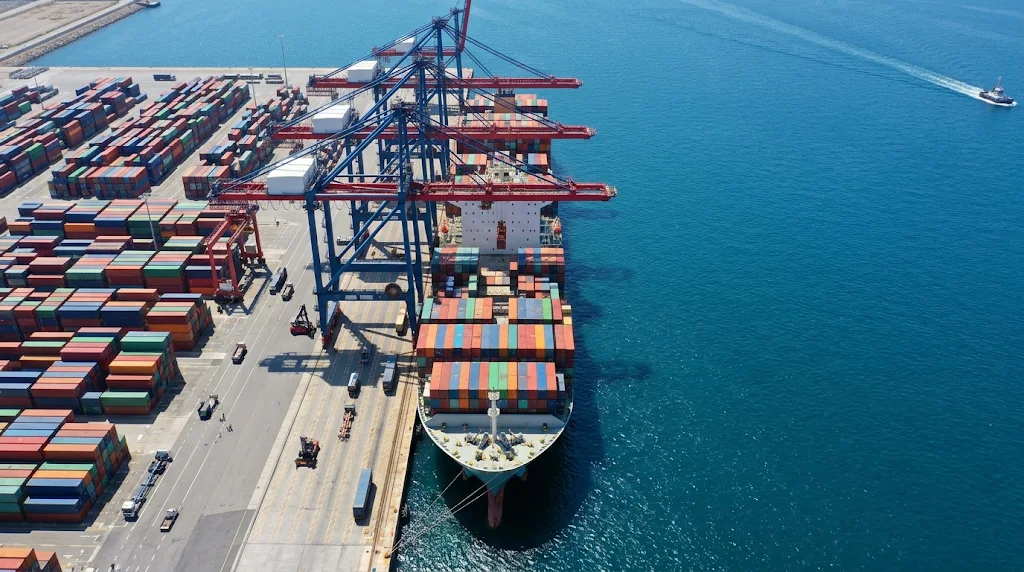
Total landed cost typically runs 1.3× to 1.7× the FOB price, depending on destination and freight market conditions. Here is a simplified example for a 20ft container of mixed building materials shipped FOB South China to Los Angeles:
| Cost item | Amount (USD) | Notes |
| Product cost (FOB) | 18,000 | Cabinets, hardware, tile trim |
| Origin handling & trucking | 450 | Factory to port |
| Ocean freight | 2,400 | 20ft container, market rate |
| Marine insurance | 180 | ~110% of CIF value |
| Destination charges | 950 | Terminal, customs, drayage |
| Import duty & fees | 2,160 | Estimated, varies by HS code |
| Inland delivery | 600 | Port to warehouse |
| Total landed cost | 24,740 | ~1.37× FOB price |
Even at 1.37× FOB, the landed price commonly sits 30–50% below equivalent local procurement — which is precisely why the global trade volume keeps flowing. For context, China exported USD 22.67 billion of building materials in the first eight months of 2025 alone (China Building Materials Federation), with growth to markets such as India, Singapore, the UAE, and Saudi Arabia offsetting softness elsewhere.
Timeline: How Long Does the Full Cycle Take?
Handled as a managed process, the complete cycle from first inquiry to delivered container takes 45 to 60 days:
- Weeks 1–2: Brief, shortlist, quotations
- Weeks 2–3: Samples and approval
- Weeks 3–8: Production (6–10 weeks is typical for custom cabinetry and doors)
- Weeks 8–9: Pre-shipment inspection and balance payment
- Weeks 9–13: Ocean freight (varies by destination) and customs clearance
Order early. Production lead times of several weeks mean building materials belong at the top of your project schedule, not the bottom.
Common Mistakes First-Time Importers Make
- Buying on price alone — the cheapest quote usually means thinner materials and weaker hardware; lifecycle cost ends up higher.
- Ignoring destination building codes — materials must comply with the standards of the country where the building stands, not where they are made.
- Skipping inspections — a USD 300–500 pre-shipment inspection is the cheapest insurance in international trade.
- Underestimating weight — tile, stone, and sanitary ware are extremely heavy; freight planning drives real savings.
- Accepting hand samples — always approve samples from the actual production line.
- Poor scheduling — a delayed container can stall an entire fit-out crew at daily burn rates that dwarf any savings.
Frequently Asked Questions
What building materials are most commonly imported from China? Kitchen cabinets and wardrobes, doors and windows, flooring (engineered wood, SPC, laminate), ceramic and porcelain tile, sanitary ware and bathroom fixtures, lighting, furniture, hardware, stairs, and hotel FF&E supplies. China is the world’s largest producer in most of these categories.
What is the typical MOQ for building materials from China? Standard hardware often starts at 1,000–3,000 pieces per SKU. Custom cabinets, doors, and furniture are usually quoted per project or per container rather than per piece. A one-stop supplier can consolidate multiple categories into a single container, effectively removing the MOQ barrier for smaller projects.
Do Chinese building materials meet Western standards? Reputable export factories routinely produce to ASTM, EN, CARB, CE, and AS/NZS standards — but you must verify test reports independently and inspect production. Never rely on unsupported claims.
How much can a project realistically save? Industry procurement experience consistently shows 30–60% savings on material cost versus local procurement for comparable specifications, after all landed costs. The exact figure depends on category mix, destination, and freight market conditions.
What payment terms are normal? 30% deposit with order confirmation, 70% balance before shipment, with inspection rights. Letters of credit are common for large project orders.
Source Everything in One Place
George Group is a Foshan-based building materials supplier providing one-stop sourcing and export across 12 product categories — kitchen cabinets, doors & windows, wardrobes, furniture, lighting, flooring, appliances, metal & glass, tile, sanitary ware, stairs, and hotel supplies. From single-container orders to complete turnkey fit-out packages for villas, apartments, hotels, and offices, our team manages specification, factory coordination, quality control, consolidation, and logistics under one accountable roof.
Send us your bill of quantities and get a practical quotation within 48 hours → Contact us
Sources: Fortune Business Insights – Construction Materials Market; Grand View Research – Green Building Materials Market; General Administration of Customs of China trade statistics (2024–2025); China Building Materials Federation export data (2025); Mordor Intelligence – Kitchen Cabinets Market. For market context, see our companion report: Global Building Materials Market Trends 2026.